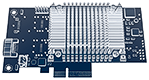
All hardware requires drivers to function. Since operating systems come pre-installed with basic drivers, some network cards can be installed without additional drivers. However, if the operating system lacks the necessary driver, you must install it. Below is how to install drivers in Windows systems, a method applicable to most scenarios.

CDFP stands for “CD Form-factor Pluggable,” where “CD” represents the Latin numeral for 400. This signifies that the interface was originally designed for a total data transfer rate of 400Gb/s, comprised of 16 channels each operating at 25Gb/s. It is an interface standard born to meet the demands of high-speed data transmission. In today's digital age, data is growing exponentially, posing unprecedented challenges to the speed, stability, and efficiency of data transmission. The CDFP interface, with its outstanding performance, has emerged to fill this critical gap in the field.
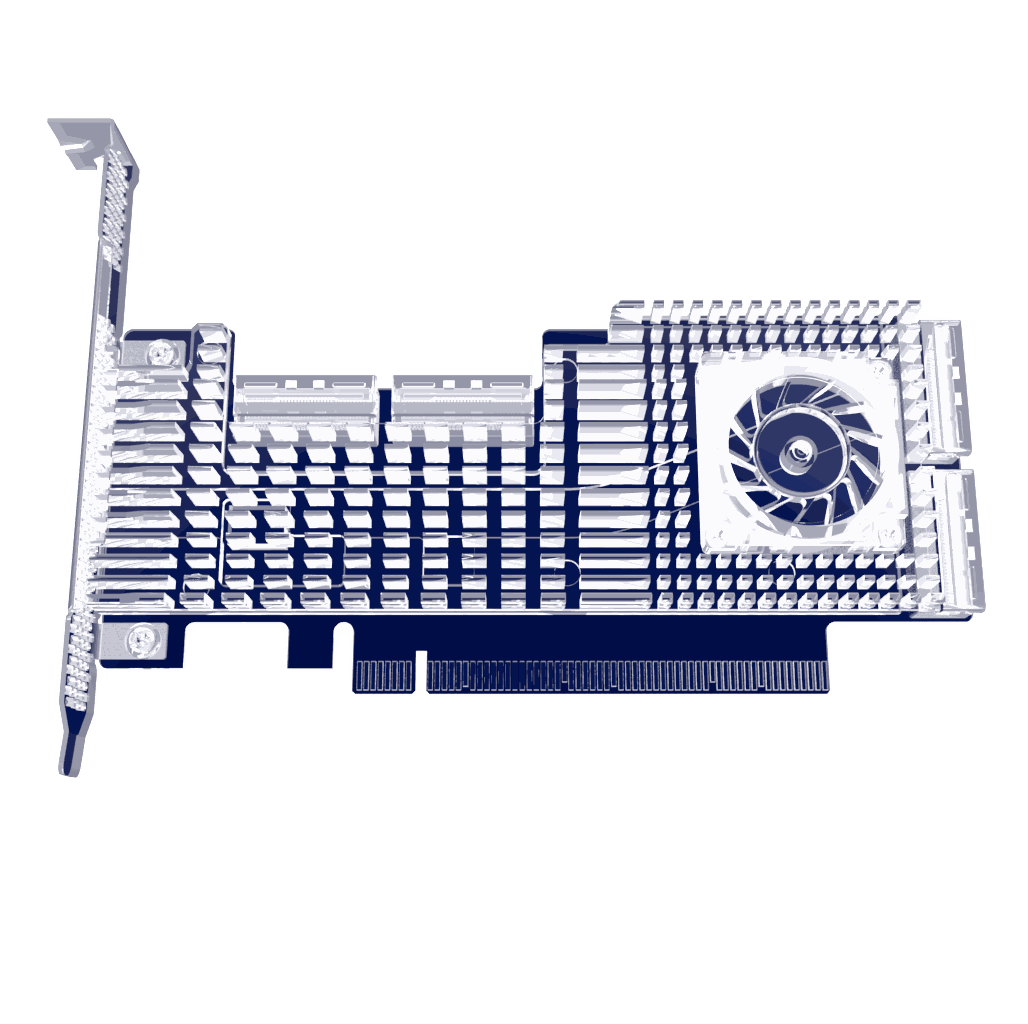
With the explosive growth in computing demands for applications like AI training, high-performance computing, and scientific simulation, single GPU servers struggle to meet the real-time processing needs of massive datasets. LR-LINK's LRNV9F24, LRNV9F48, and LRNV9F96-10I series expansion devices deliver high-bandwidth, low-latency, and flexibly scalable storage solutions to unlock the full potential of GPU computing power.
Computer hardware components each fulfill their specific roles, while the PCIe interface acts as a highway connecting memory, hard drives, networks, and the CPU. PCIe, short for Peripheral Component Interconnect Express, is a high-speed serial computer expansion bus standard primarily responsible for connecting various internal hardware components. Compared to the traditional PCI bus, PCIe employs a point-to-point bidirectional communication standard, significantly boosting bandwidth, reducing latency, and enabling more efficient and seamless data exchange between hardware components.
RAID cards, fully known as Redundant Array of Independent Disks cards, are widely used in data centers, servers, network storage, and other fields. RAID cards achieve data fault tolerance and redundancy through different RAID levels. This article explains how to set up a RAID array.
With the development of RAID storage technology, significant breakthroughs have been made over the past few decades, providing higher reliability and performance for data storage. Future RAID storage will face greater challenges and opportunities, and new technologies and innovations will drive further advancements in RAID storage in terms of fault tolerance, performance, scalability, and cost-effectiveness
Today is digital age, the importance of network interfaces as the critical components connecting devices to networks is self-evident. Serving as the hardware/software interaction point for data exchange between devices and networks, network interfaces undertake key tasks such as protocol conversion, signal modulation, and data encapsulation.
How to check if your motherboard supports PCIe bifurcation? You can follow these steps: First, consult the motherboard's specifications, which typically indicates the supported features clearly. Second, visit the manufacturer's website to review relevant technical documentation. Finally, check the BIOS settings or use third-party tools to verify bifurcation support.
PoE (Power over Ethernet) is a technology that allows data to be transmitted over Ethernet cables while simultaneously supplying power to connected devices. Traditionally, network devices (such as IP cameras, wireless access points, IP phones, etc.) required independent power supplies, which could lead to complex wiring, high costs, and dependence on power outlets. The advent of PoE technology has solved these problems, providing greater flexibility and convenience for the deployment of network devices.
RAID is a technology used to enhance data storage performance and reliability.A RAID system consists of two or more drives operating in parallel, which can be hard disks or SSDs (solid-state drives).It is mainly divided into several types: RAID 0, 1, 5, 6, 10, 50, and 60.
InfiniBand: InfiniBand technology, abbreviated as IB, is a network communication standard and a protocol of RDMA technology. It uses high-speed differential signal technology and multi-channel parallel transmission mechanism. Its main goal is to provide high performance, low latency and high reliability.
A PCIe Retimer is a hardware component used to enhance the signal integrity of PCI Express (PCIe). Its primary function is to regenerate and recover PCIe signals, ensuring that signal quality and stability are maintained during long-distance transmissions or in complex topological structures.