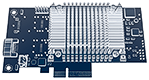
RAID cards, fully known as Redundant Array of Independent Disks cards, are widely used in data centers, servers, network storage, and other fields. RAID cards achieve data fault tolerance and redundancy through different RAID levels. This article explains how to set up a RAID array.

With the development of RAID storage technology, significant breakthroughs have been made over the past few decades, providing higher reliability and performance for data storage. Future RAID storage will face greater challenges and opportunities, and new technologies and innovations will drive further advancements in RAID storage in terms of fault tolerance, performance, scalability, and cost-effectiveness
How to check if your motherboard supports PCIe bifurcation? You can follow these steps: First, consult the motherboard's specifications, which typically indicates the supported features clearly. Second, visit the manufacturer's website to review relevant technical documentation. Finally, check the BIOS settings or use third-party tools to verify bifurcation support.
PoE (Power over Ethernet) is a technology that allows data to be transmitted over Ethernet cables while simultaneously supplying power to connected devices. Traditionally, network devices (such as IP cameras, wireless access points, IP phones, etc.) required independent power supplies, which could lead to complex wiring, high costs, and dependence on power outlets. The advent of PoE technology has solved these problems, providing greater flexibility and convenience for the deployment of network devices.
RAID is a technology used to enhance data storage performance and reliability.A RAID system consists of two or more drives operating in parallel, which can be hard disks or SSDs (solid-state drives).It is mainly divided into several types: RAID 0, 1, 5, 6, 10, 50, and 60.
InfiniBand: InfiniBand technology, abbreviated as IB, is a network communication standard and a protocol of RDMA technology. It uses high-speed differential signal technology and multi-channel parallel transmission mechanism. Its main goal is to provide high performance, low latency and high reliability.
A PCIe Retimer is a hardware component used to enhance the signal integrity of PCI Express (PCIe). Its primary function is to regenerate and recover PCIe signals, ensuring that signal quality and stability are maintained during long-distance transmissions or in complex topological structures.
PCIe (Peripheral Component Interconnect Express) is a computer bus standard used to connect various hardware devices inside a computer, such as graphics cards, expansion cards, storage devices, etc. It is an evolution of the PCI (Peripheral Component Interconnect) bus, designed to provide higher data transfer speeds and improved performance.
the high cost of re-acquisition of servers, and more cost-effective GPU expansion on the original equipment?
GPU technology is advancing rapidly, and businesses that leverage GPU expansion in their render farms are better positioned to meet future demands. From real-time rendering to AI-driven content creation, GPU expansion can effectively improve the efficiency of render farms.
In today's digital age, cyber security has become a global focus. With the rapid development of information technology, the means and scale of cyber attacks are constantly escalating, posing huge threats to individuals, enterprises and countries. In order to solve this problem, LR-LINK launched the 25G Bypass network security solution, which provides a powerful network fault response capability and ensures the continuous and stable operation of the network.
LR-LINK Frame Grabber possess characteristics such as high stability, zero packet loss, and no frame dropping. They can be applied not only in the industrial field but also widely in various application areas including industrial production, national defense and military, new energy, biomedicine, and intelligent transportation.