MTU (Maximum Transmission Unit) is the largest size of a network frame or packet that can be transmitted in a single network layer transaction without fragmentation. Measured in bytes, MTU is determined by the network interface and protocol specifications. Standard Ethernet uses an MTU of 1500 bytes, while jumbo frames support MTU values up to 9000 bytes or higher. MTU affects network efficiency, latency, and throughput—larger MTU values reduce per-packet overhead but increase latency for small transmissions (IEEE 802.3-2018 standard).
MTU governs how data is packaged for network transmission:
Frame Structure: Every Ethernet frame consists of a header (14 bytes), payload (variable up to MTU), and Frame Check Sequence (4 bytes). The MTU defines the maximum payload size, not the total frame size.
Fragmentation: When a packet exceeds the MTU of any link in its path, it must be fragmented into smaller pieces. Each fragment is transmitted separately and reassembled at the destination, adding overhead and latency.
Path MTU Discovery: Modern networks use Path MTU Discovery (PMTUD, RFC 1191) to determine the smallest MTU along the path between source and destination, avoiding fragmentation by adjusting packet sizes proactively.
MTU Mismatch: If devices on the same network segment have different MTU settings, communication issues occur. All devices in a broadcast domain should use the same MTU for optimal performance.
Standard MTU values: Ethernet (1500 bytes), Jumbo Frame (9000 bytes), Baby Giant (1600 bytes for VLAN tagging overhead), and PPPoE (1492 bytes due to 8-byte overhead).
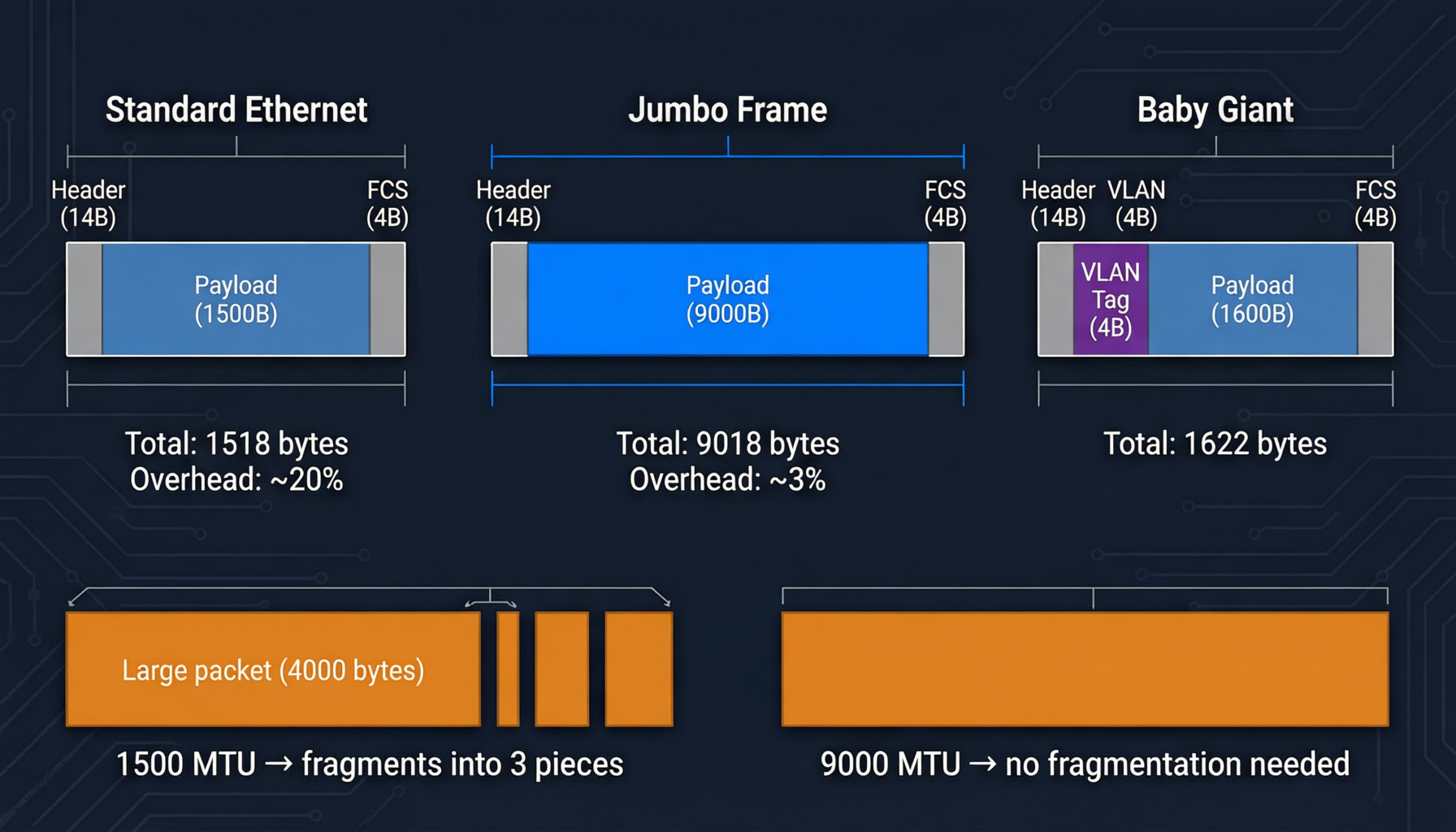
Reduced Overhead: Larger MTU values reduce the ratio of header bytes to payload bytes. A 9000-byte jumbo frame has ~3% overhead vs ~20% for standard 1500-byte frames, improving effective throughput by 15-20% (Network World, 2023).
Lower CPU Utilization: Fewer frames per second means fewer interrupts for NICs and CPUs. A 10GbE connection with 9000-byte MTU generates ~148,000 interrupts/sec vs ~880,000 interrupts/sec with 1500-byte MTU.
Improved Storage Performance: iSCSI and NFS storage protocols benefit significantly from jumbo frame MTU. Large block transfers achieve near-line-rate throughput with reduced latency.
Better RDMA Efficiency: RDMA protocols leverage large MTU to maximize payload per transaction, reducing round-trips required for large memory transfers.
Storage Area Networks: iSCSI and NFS storage traffic uses jumbo frame MTU (9000 bytes) to maximize throughput for large block transfers. LR-LINK LRES1027PF-4SFP28 supports jumbo frames for high-performance storage networking.
Virtual Machine Migration: Live migration of VMs between hypervisors transfers entire memory images. Jumbo frame MTU reduces migration time by 20-30% compared to standard 1500-byte MTU.
Backup and Replication: Backup operations transfer large datasets between servers and storage arrays. Jumbo frame MTU improves backup throughput and reduces backup window times.
High-Performance Computing: HPC clusters use jumbo frame MTU for MPI communication between compute nodes, reducing latency for large message transfers in distributed simulations.
Related Technologies
NIC handles MTU segmentation and reassembly. Modern server NICs like LR-LINK LRES1027PF-4SFP28 support jumbo frames up to 9000 bytes with hardware offloading for efficient processing.
Jumbo Frame is the common term for frames with MTU larger than 1500 bytes. The most common jumbo frame MTU is 9000 bytes, though some devices support up to 9216 bytes.
VLAN tagging adds 4 bytes to the Ethernet frame header (802.1Q tag), effectively reducing the available payload MTU by 4 bytes unless the interface MTU is increased accordingly.
SFP28 links benefit from jumbo frame MTU for maximum throughput. At 25GbE, jumbo frames enable near-line-rate efficiency for large data transfers between servers and switches.
MTU defines the maximum frame size for network transmission, directly impacting efficiency, latency, and throughput. While standard Ethernet uses 1500 bytes, jumbo frames (9000 bytes) reduce overhead and improve performance for large data transfers. Proper MTU configuration across all network devices is essential for avoiding fragmentation and maximizing network efficiency in data center, storage, and HPC environments.