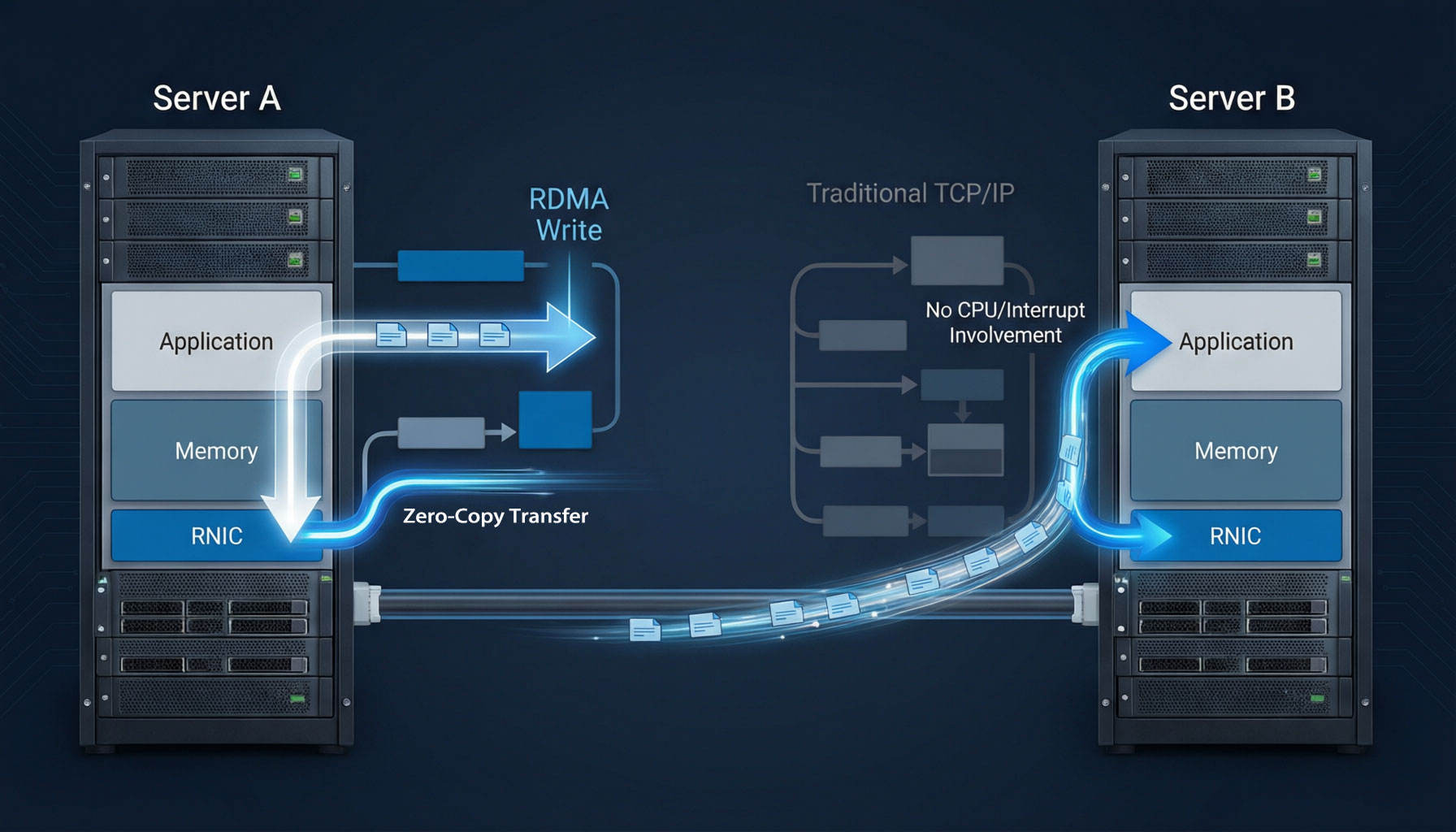
RDMA (Remote Direct Memory Access) is a network protocol that enables direct memory access from one server to another without involving the operating system kernel or CPU on either end. Originally developed for high-performance computing and later standardized for Ethernet (RoCE, iWARP), RDMA eliminates data copying and context switching overhead, achieving sub-10-microsecond latency and near-line-rate throughput for distributed applications (IETF RFC 5044, RDMA Consortium).
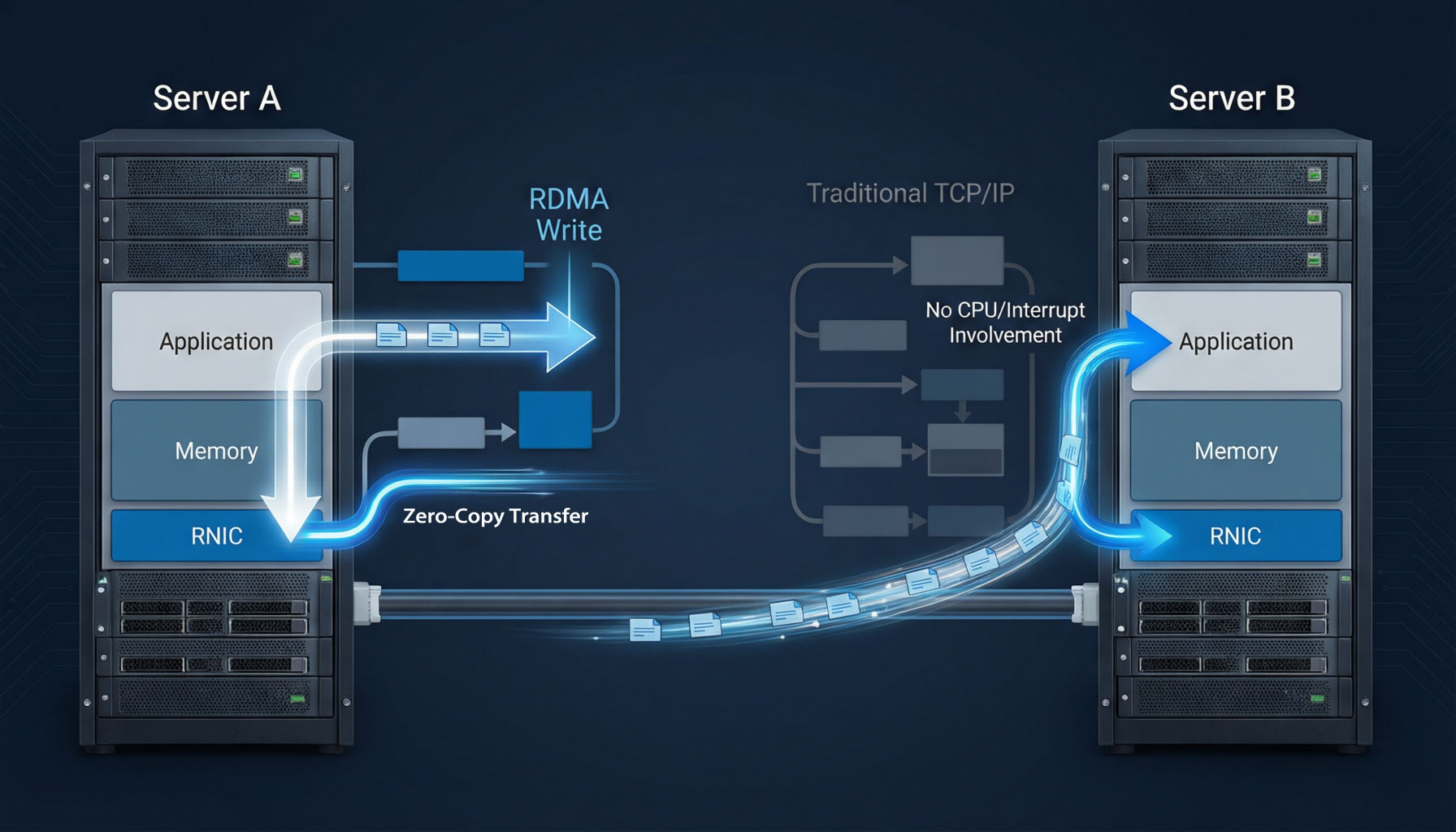
Traditional network communication requires data to be copied from application memory to kernel buffers, then to the NIC, transmitted over the network, and copied back through the same path on the receiving end. RDMA bypasses this entire process:
Zero-Copy Transfer: The application registers its memory buffers with the RNIC (RDMA-capable NIC). The RNIC directly reads from or writes to application memory without kernel involvement, eliminating memory copy operations.
Kernel Bypass: The application communicates directly with the RNIC through a user-space library (libibverbs), bypassing the OS network stack entirely. This eliminates context switches and interrupt handling overhead.
Remote Memory Access: Using RDMA Read or RDMA Write operations, Server A can directly read from or write to Server B registered memory region. The remote server CPU is not interrupted during the transfer.
The RNIC handles all network protocol processing (packetization, checksums, flow control) in hardware, freeing the CPU for application workloads.
Ultra-Low Latency: RDMA achieves network latency as low as 1-2 microseconds for small messages, compared to 10-50 microseconds for traditional TCP/IP. This is critical for high-frequency trading, real-time analytics, and distributed databases (Mellanox RDMA Performance Study, 2023).
High Throughput: By eliminating CPU overhead and memory copies, RDMA enables near-line-rate throughput even at 100GbE and 200GbE speeds. A single CPU core can handle millions of messages per second with RDMA.
CPU Efficiency: RDMA offloads network processing to the RNIC hardware, freeing 20-40% of CPU cycles that would otherwise handle TCP/IP stack processing. This is especially valuable in virtualized environments where CPU resources are shared.
Scalability: RDMA supports millions of concurrent connections with minimal CPU overhead, making it ideal for large-scale distributed systems, cloud computing, and HPC clusters.
High-Performance Computing (HPC): HPC clusters use RDMA (typically over InfiniBand or RoCE) for inter-node communication in distributed computing workloads. MPI (Message Passing Interface) applications leverage RDMA for fast data exchange between compute nodes, enabling simulations, weather modeling, and scientific computing at scale.
Distributed Databases: Modern distributed databases (Apache Cassandra, MongoDB, CockroachDB) use RDMA for replication and consensus protocols. RDMA ensures that data consistency operations (Raft, Paxos) complete in microseconds rather than milliseconds, improving transaction throughput.
Cloud Computing: Public cloud providers deploy RDMA-capable NICs to enable high-performance networking for tenant VMs. SR-IOV combined with RDMA allows VMs to achieve bare-metal network performance, supporting demanding workloads like real-time video processing and financial trading.
Artificial Intelligence: AI training clusters use RDMA for gradient synchronization across multiple GPUs and nodes. Frameworks like TensorFlow and PyTorch leverage RDMA for efficient parameter server communication, reducing training time for large language models.
Related Technologies
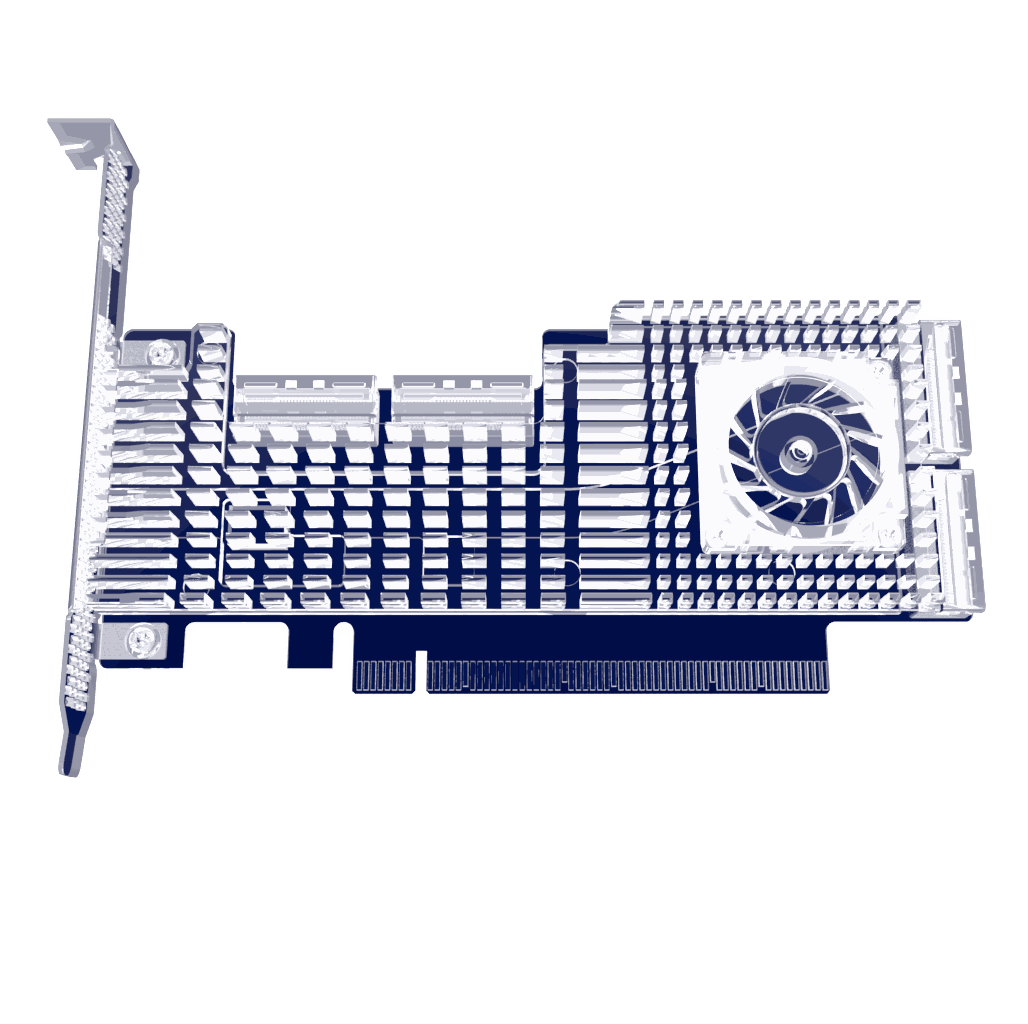
NIC implements RDMA as a standard feature in modern server adapters. LR-LINK LRES1027PF-4SFP28 supports RoCE v2 for 25GbE RDMA, enabling low-latency networking for HPC and cloud workloads.
SR-IOV enables RDMA passthrough to virtual machines. With SR-IOV-assigned virtual functions, VMs can use RDMA directly without hypervisor mediation, achieving near-bare-metal performance in virtualized environments.
PCIe Lane determines the bandwidth available to RDMA NICs. A Gen4 x16 slot provides 64 GB/s, sufficient for 200GbE RDMA with headroom for storage and compute traffic.
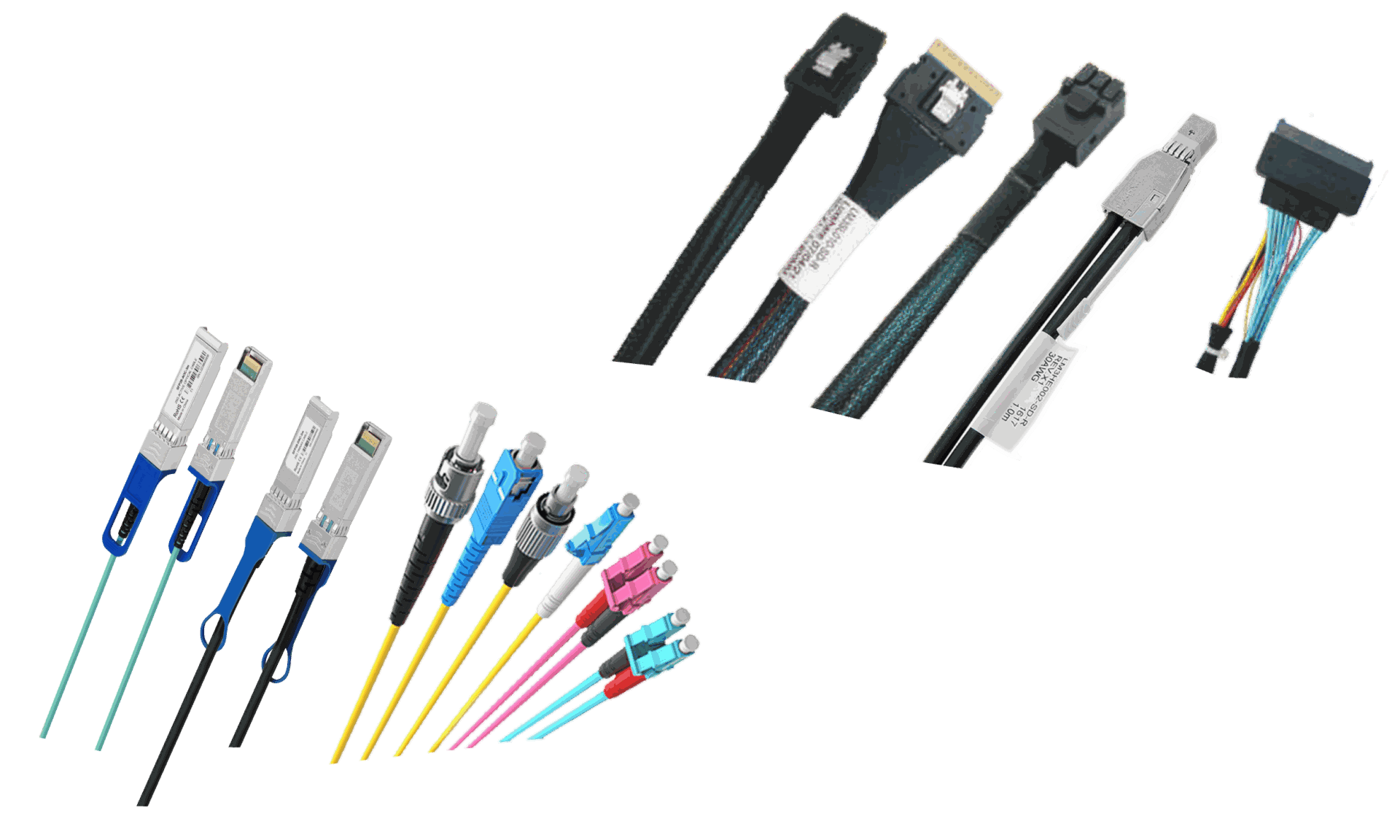
SFP28 is the transceiver form factor commonly used for 25GbE RDMA connections. SFP28 supports both fiber optic and direct-attach copper (DAC) cables for short-reach data center interconnects.
RDMA transforms network communication by enabling direct memory access between servers without CPU or kernel involvement. Through zero-copy transfer and kernel bypass, RDMA delivers ultra-low latency, high throughput, and CPU efficiency for demanding workloads. Whether running HPC simulations, distributed databases, cloud services, or AI training, RDMA ensures that network performance never becomes a bottleneck.