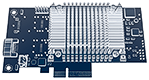
SR-IOV (Single Root I/O Virtualization) is a PCI-SIG specification that enables a single physical PCIe device to appear as multiple separate virtual devices to a hypervisor. Introduced in 2007 and widely adopted in modern network adapters, storage controllers, and GPUs, SR-IOV allows virtual machines to directly access hardware resources without hypervisor mediation, significantly reducing I/O overhead and improving performance in virtualized environments (PCI-SIG SR-IOV Specification, Rev 1.1).
SR-IOV extends the PCIe standard to support hardware-level virtualization through two types of functions:
Physical Function (PF): The full-featured PCIe function that manages the physical device. The PF handles configuration, resource allocation, and creation of Virtual Functions. It appears as a standard PCIe device to the hypervisor.
Virtual Function (VF): A lightweight PCIe function that contains only the resources needed for data movement. Each VF has its own PCI configuration space, memory space, and interrupt vectors (MSI-X), but shares the physical hardware with other VFs and the PF.
The hypervisor assigns VFs directly to virtual machines using PCIe passthrough. Each VM sees its assigned VF as a dedicated physical device, enabling native driver installation and direct hardware access without emulated device overhead.

Near-Native Performance: VMs access hardware directly through VFs, bypassing the hypervisor software switch. Network latency drops to under 5 microseconds, comparable to bare-metal performance (Intel SR-IOV Performance Study, 2023).
Reduced CPU Overhead: By eliminating hypervisor-mediated I/O processing, SR-IOV frees 15-30% of CPU cycles that would otherwise handle virtual switch operations, making more cores available for application workloads.
Hardware Isolation: Each VF operates independently with dedicated memory spaces and interrupt vectors, providing strong isolation between VMs while sharing the same physical device.
Scalability: A single SR-IOV-capable NIC can support 64-256 VFs, enabling high-density virtualization without requiring one physical NIC per VM.
Cloud Computing: Public cloud providers (AWS, Azure, GCP) use SR-IOV to deliver high-performance networking to tenant VMs. SR-IOV enables consistent low-latency connectivity for database clusters, real-time analytics, and HPC workloads running in virtualized environments.
Network Function Virtualization (NFV): Telecommunications operators deploy SR-IOV to run virtualized network functions (vRAN, vEPC, virtual routers) with deterministic performance. SR-IOV ensures that packet processing meets strict latency requirements for 5G baseband processing.
High-Performance Computing: HPC clusters use SR-IOV to enable RDMA over Converged Ethernet (RoCE) passthrough to VMs, allowing distributed computing applications to achieve sub-10-microsecond inter-node communication without dedicated physical adapters per node.
Related Technologies
PCIe Lane determines the bandwidth available to SR-IOV virtual functions. A Gen4 x16 slot provides 64 GB/s shared across all VFs, sufficient for 100GbE networking with headroom for storage and compute traffic.
NIC implements SR-IOV as a standard feature in modern server adapters. LR-LINK LRES1027PF-4SFP28 and LRES1030PF-4SFP+ both support SR-IOV with up to 64 virtual functions per port.
MSI-X provides the interrupt mechanism that allows each VF to deliver interrupts directly to its assigned VM, eliminating interrupt sharing bottlenecks that plague legacy INTx interrupts.
RDMA leverages SR-IOV to enable zero-copy, kernel-bypass networking in virtualized environments. VMs with SR-IOV-assigned VFs can use RoCE for direct memory access across the network without hypervisor involvement.
SR-IOV transforms virtualized infrastructure by enabling direct hardware access for virtual machines. Through its Physical Function and Virtual Function architecture, SR-IOV delivers near-bare-metal performance, reduces CPU overhead, and scales to support high-density VM deployments. Whether running cloud workloads, NFV applications, or HPC clusters, SR-IOV ensures that virtualization does not compromise network performance.