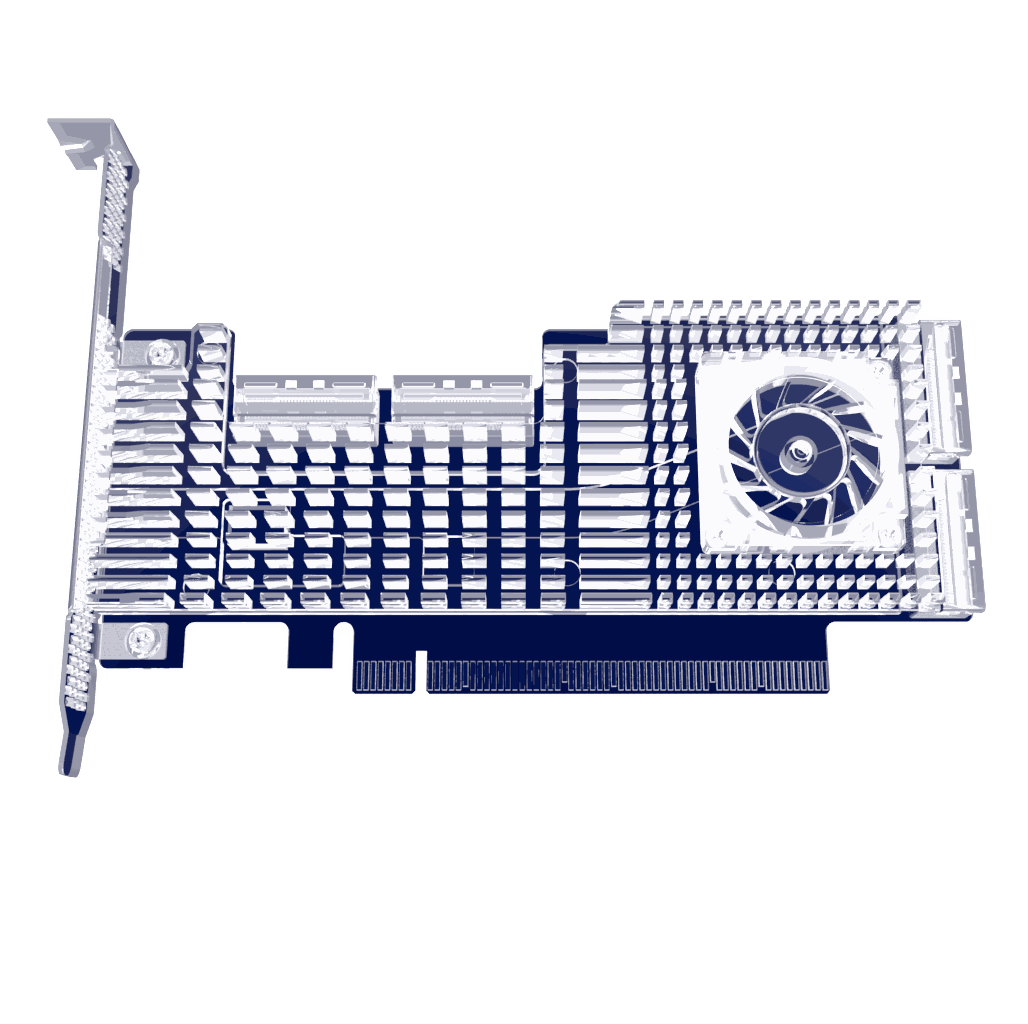
A PCIe (Peripheral Component Interconnect Express) lane is a single full-duplex serial connection consisting of two differential signal pairs: one for transmitting (Tx) and one for receiving (Rx) data. Each lane operates independently and can transfer data simultaneously in both directions. PCIe lanes are the fundamental building blocks of the PCIe bus, with devices configured as x1, x4, x8, or x16 based on the number of lanes they require (PCI-SIG PCI Express Base Specification, Rev 5.0).
Each PCIe lane contains two unidirectional differential pairs, enabling simultaneous bidirectional communication:
Transmit Pair (Tx+ / Tx-): Carries data from the root complex (CPU/chipset) to the endpoint device. The differential signaling rejects common-mode noise, enabling reliable high-speed transmission over PCB traces.
Receive Pair (Rx+ / Rx-): Carries data from the endpoint device back to the root complex. Like the transmit pair, it uses differential signaling for noise immunity.
Packet-Based Protocol: Data is transmitted as packets containing headers, payload, and CRC checksums. Each lane operates at the negotiated generation speed (Gen3: 8 GT/s, Gen4: 16 GT/s, Gen5: 32 GT/s).
Multiple lanes are aggregated to increase bandwidth. A x4 link uses 4 lanes (8 differential pairs total), providing 4x the bandwidth of a x1 link. The PCIe controller dynamically manages lane allocation and can disable faulty lanes while maintaining operation at reduced bandwidth.
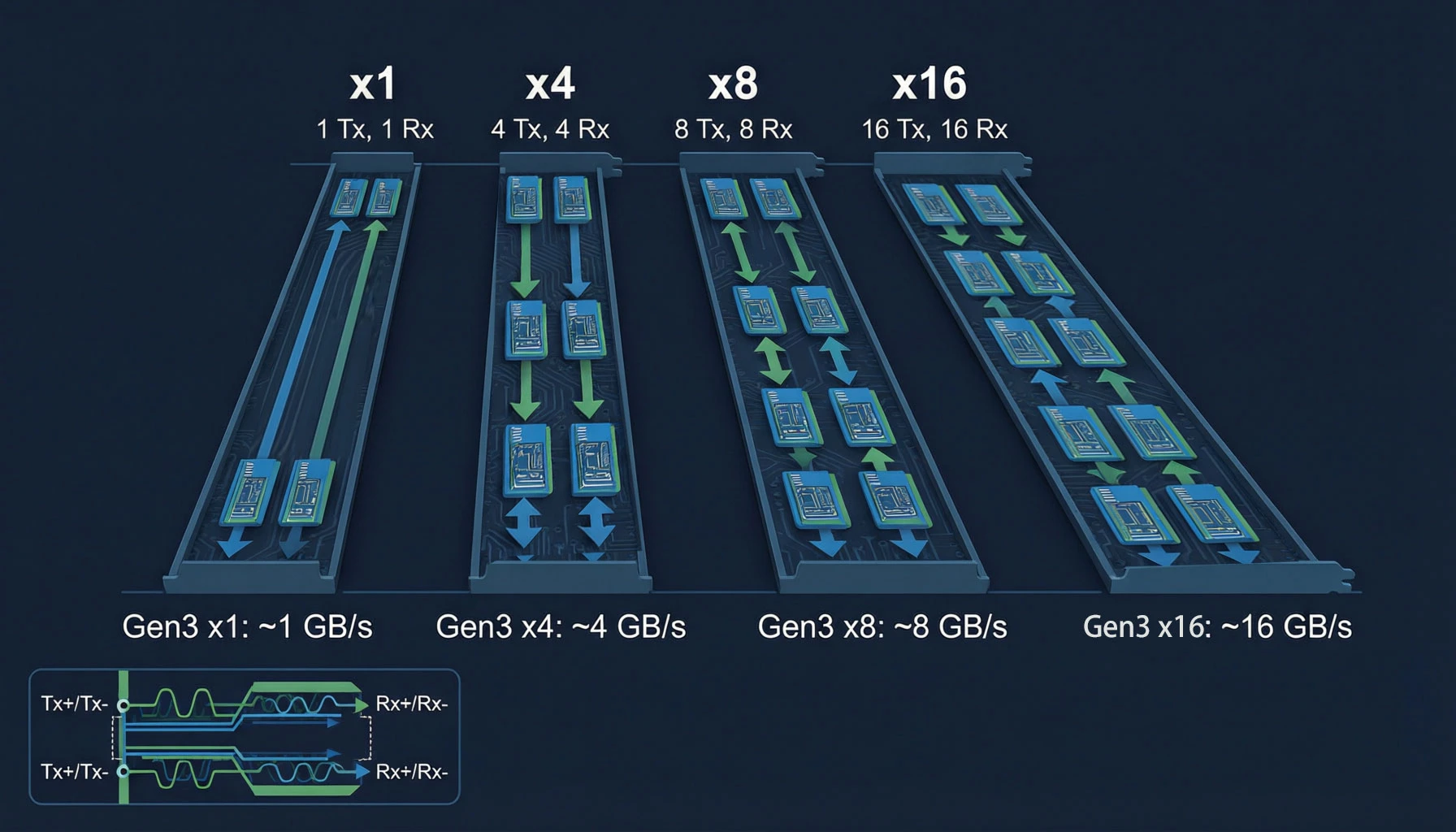
Scalable Bandwidth: PCIe lane count scales from x1 (1 lane) to x16 (16 lanes), allowing devices to match bandwidth requirements. A Gen4 x16 slot delivers 64 GB/s bidirectional bandwidth, sufficient for 200GbE networking and high-end GPUs (PCI-SIG, 2022).
Full-Duplex Operation: Unlike shared-bus architectures, each PCIe lane supports simultaneous transmit and receive, eliminating contention and maximizing throughput for bidirectional workloads.
Hot-Plug Support: PCIe lanes support hot-plug functionality, allowing devices to be added or removed without system shutdown. This is critical for data center maintenance and expansion.
Error Detection: Each lane implements CRC-32 error checking per transaction layer packet (TLP), with automatic retry and lane-level error reporting through the Advanced Error Reporting (AER) capability.
Network Interface Cards: Modern server NICs require multiple PCIe lanes to achieve line-rate performance. A 100GbE NIC typically uses PCIe Gen4 x16 (64 GB/s) to handle bidirectional traffic without bottleneck. LR-LINK LRES1027PF-4SFP28 uses PCIe Gen3 x8 for 25GbE performance.
Graphics Processing Units: High-end GPUs require PCIe Gen4 x16 for maximum bandwidth during training workloads. Data center GPUs (NVIDIA A100, AMD MI200) use PCIe Gen4 x16 to transfer model parameters and gradients between host memory and GPU memory.
NVMe Storage: NVMe SSDs leverage PCIe lanes for direct storage access. A Gen4 x4 NVMe drive achieves 7 GB/s sequential read speeds, while enterprise U.2 drives use x8 or x16 configurations for multi-terabyte-per-second aggregate bandwidth.
FPGA Accelerators: Field-programmable gate arrays used for network function virtualization and custom compute offload connect via PCIe x8 or x16 lanes, requiring high bandwidth for real-time data processing between the FPGA fabric and host memory.
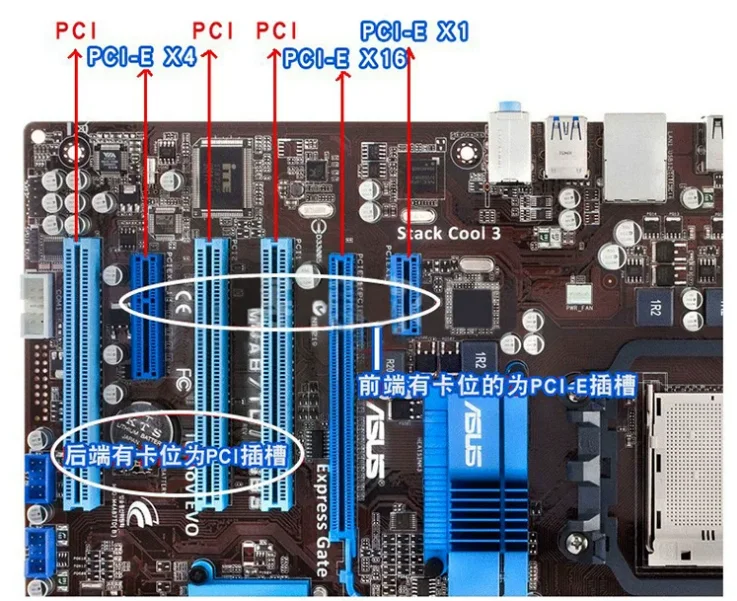
PCIe Bus is the overall architecture that aggregates multiple lanes into a coherent interconnect. The bus manages lane negotiation, power management, and error handling across all connected devices.
NIC connects to the host system via PCIe lanes. The number of lanes determines maximum network throughput: a 10GbE NIC requires x4, while 100GbE requires x16 for full line-rate performance.
SR-IOV virtual functions share the physical PCIe lanes of the parent device. All VFs on a single PF compete for the same lane bandwidth, making lane count critical for virtualized networking performance.
RDMA NICs require high-bandwidth PCIe lanes (Gen4 x8 or x16) to achieve sub-10-microsecond latency. Insufficient lane bandwidth creates a bottleneck that negates RDMA zero-copy advantages.
A PCIe lane is the fundamental unit of PCI Express connectivity, providing a full-duplex serial connection between devices. By aggregating lanes (x1 through x16) and leveraging generational speed improvements (Gen3 through Gen5), PCIe delivers scalable bandwidth for networking, storage, compute, and acceleration workloads. Understanding lane requirements is essential for designing systems that avoid I/O bottlenecks in high-performance environments.