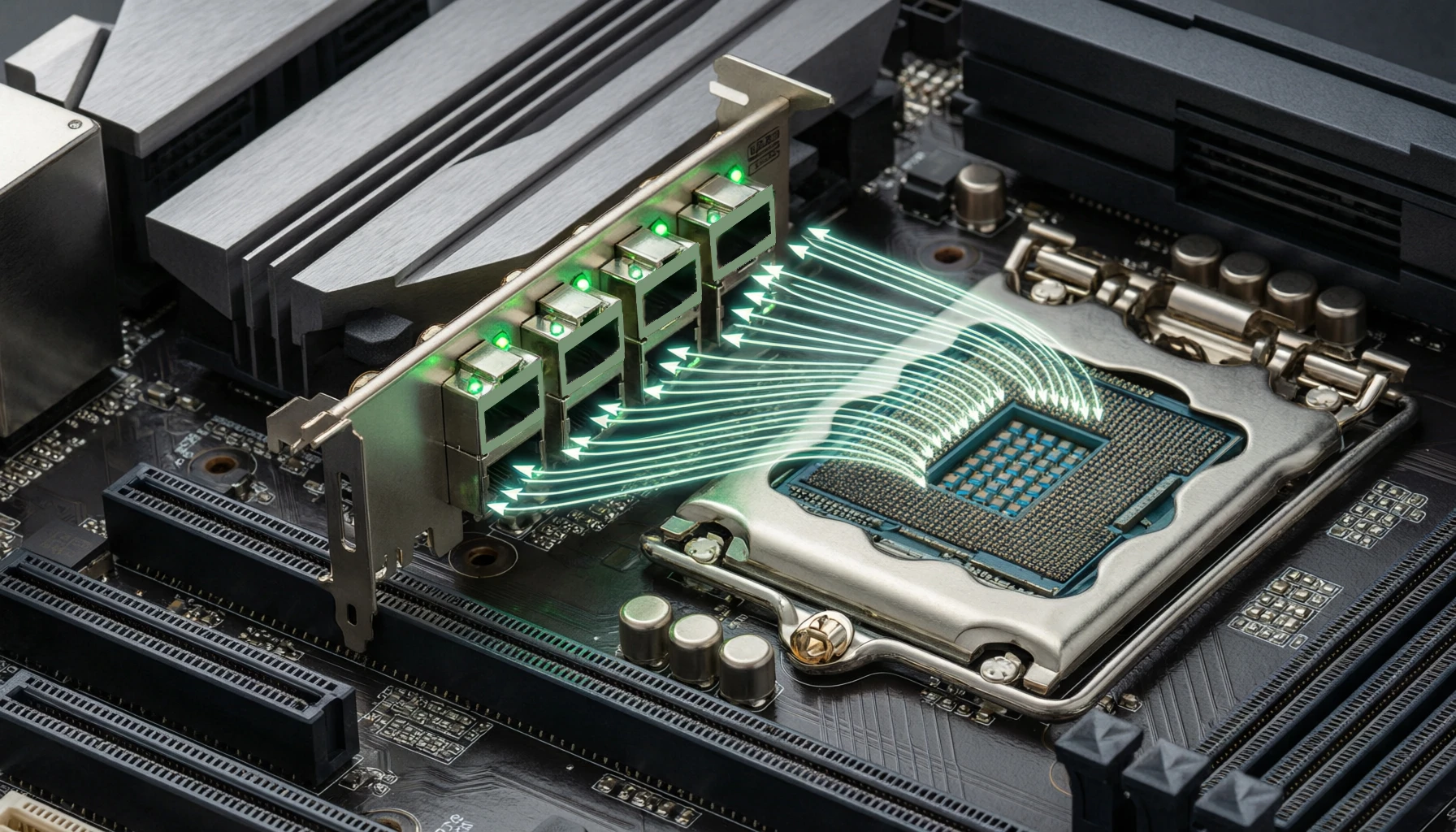
MSI-X (Message Signaled Interrupts Extended) is a PCIe interrupt mechanism defined by the PCI-SIG Base Specification. Unlike legacy INTx interrupts that use shared physical interrupt lines, MSI-X enables devices to signal interrupts by writing a small data packet (message) directly to a designated memory address. This eliminates interrupt sharing, reduces latency, and supports up to 2048 independent interrupt vectors per device (PCI-SIG PCI Express Base Specification, Rev 5.0).
MSI-X replaces the traditional pin-based interrupt mechanism with message-based signaling:
Message-Based Signaling: Instead of asserting a physical interrupt pin, the device writes a 32-bit or 64-bit data value to a specific memory address configured by the OS. This memory write is treated as an interrupt by the CPU.
Per-Vector Configuration: Each MSI-X vector has its own address and data value, allowing different interrupt sources within the same device to target different CPU cores or interrupt handlers.
Vector Table: The device maintains a table in memory (MSI-X Table) containing the address and data for each vector. The OS configures this table during device initialization.
No Interrupt Sharing: Unlike INTx where multiple devices share the same interrupt line, each MSI-X vector is dedicated to a specific function, eliminating the need for interrupt sharing and reducing latency.
The MSI-X mechanism is particularly beneficial for multi-queue devices (NICs, storage controllers) where each queue can have its own interrupt vector, enabling parallel interrupt processing across multiple CPU cores.
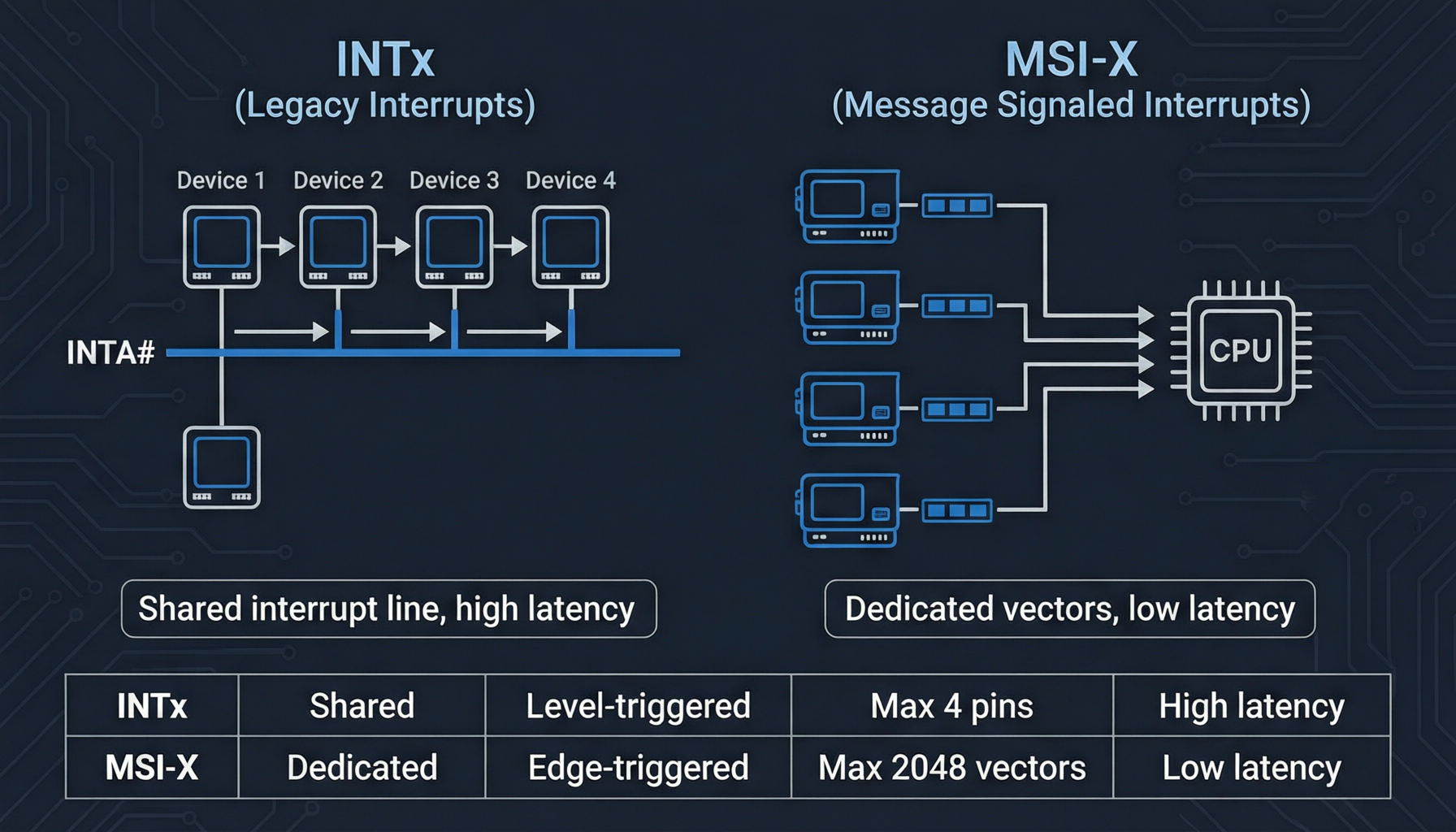
Low Latency: MSI-X eliminates the overhead of interrupt sharing and polling, achieving sub-microsecond interrupt delivery. This is critical for high-performance networking and storage applications (PCI-SIG, 2022).
Scalability: Support for up to 2048 vectors per device enables fine-grained interrupt allocation for multi-queue devices. A 4-port 25GbE NIC can assign separate vectors to each port and queue.
CPU Core Affinity: Each MSI-X vector can be routed to a specific CPU core, enabling load balancing and cache locality optimization. This is essential for RSS (Receive Side Scaling) in modern NICs.
No Interrupt Storms: MSI-X vectors are edge-triggered and automatically masked during handling, preventing interrupt storms that can occur with level-triggered INTx interrupts.
High-Performance Networking: Modern server NICs use MSI-X for per-queue interrupt delivery. LR-LINK LRES1027PF-4SFP28 assigns separate MSI-X vectors to each of its 4 ports and multiple Rx/Tx queues, enabling parallel packet processing across CPU cores.
Virtualization: SR-IOV virtual functions use MSI-X to deliver interrupts directly to VMs without hypervisor mediation. Each VF gets its own set of MSI-X vectors, providing near-bare-metal interrupt performance.
Storage Controllers: NVMe and RAID controllers leverage MSI-X for per-namespace or per-LUN interrupt delivery, reducing latency for I/O operations and improving throughput.
RDMA Networking: RDMA-capable NICs use MSI-X for completion queue interrupts, ensuring that application threads are notified immediately when data transfers complete, minimizing latency.
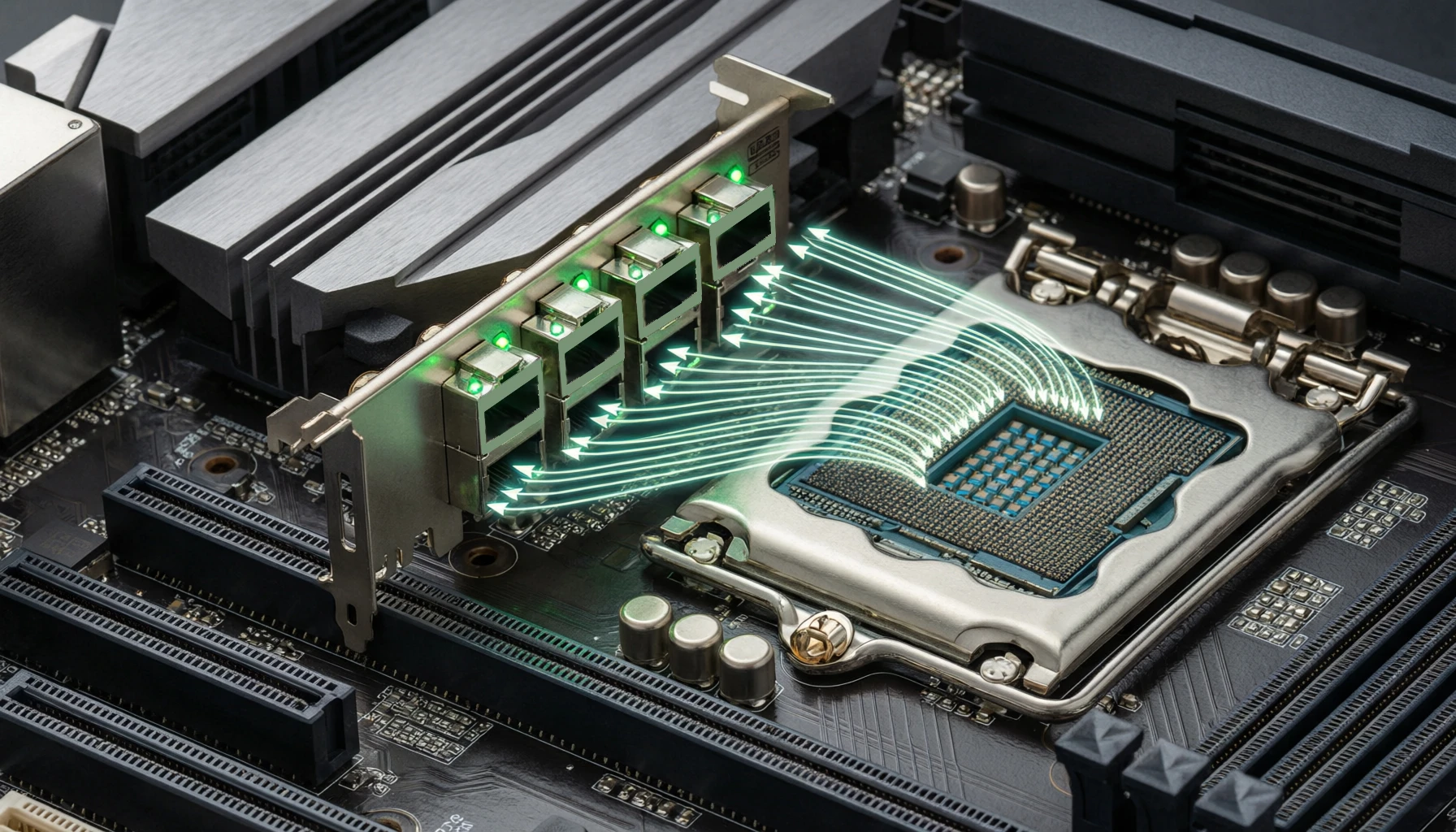
PCIe Lane delivers MSI-X interrupt messages from the device to the CPU. The interrupt write transaction travels over the same PCIe lanes used for data transfer.
NIC implements MSI-X for efficient interrupt handling. Modern server NICs like LR-LINK LRES1027PF-4SFP28 support 2048 MSI-X vectors, enabling per-queue interrupt delivery for all 4 ports.
SR-IOV virtual functions use MSI-X interrupts for efficient interrupt delivery to VMs. Each VF can have up to 2048 vectors, providing dedicated interrupt resources without sharing.
RDMA NICs leverage MSI-X for low-latency interrupt delivery. Completion queue interrupts are delivered via MSI-X vectors, ensuring immediate notification when RDMA operations complete.
MSI-X is the modern PCIe interrupt mechanism that replaces legacy INTx with message-based signaling. By eliminating interrupt sharing, supporting per-vector configuration, and enabling up to 2048 vectors per device, MSI-X delivers low latency, scalability, and CPU core affinity for high-performance networking, storage, and virtualization workloads. Understanding MSI-X is essential for optimizing interrupt handling in data center environments.