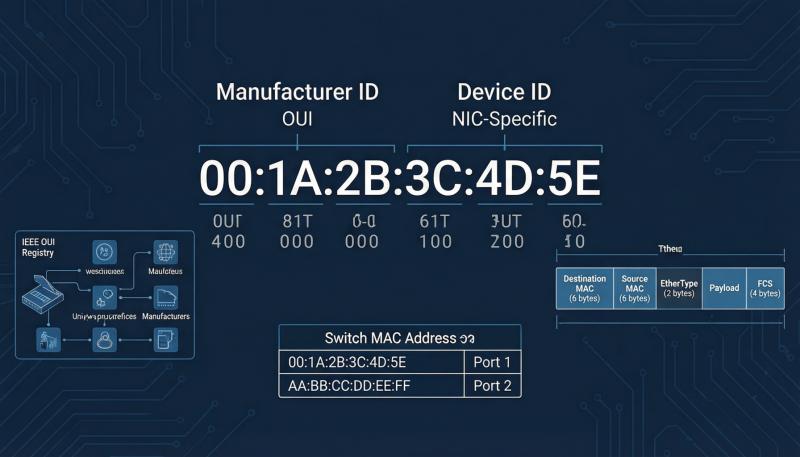
A MAC (Media Access Control) address is a unique 48-bit hardware identifier assigned to every network interface controller (NIC) during manufacturing. Also known as a physical address or hardware address, it operates at the data link layer (Layer 2) of the OSI model and is used to identify devices on a local network segment. MAC addresses are burned into the NIC firmware (EEPROM) and expressed as six pairs of hexadecimal digits separated by colons or hyphens (e.g., 00:1A:2B:3C:4D:5E) (IEEE 802-2001 standard).
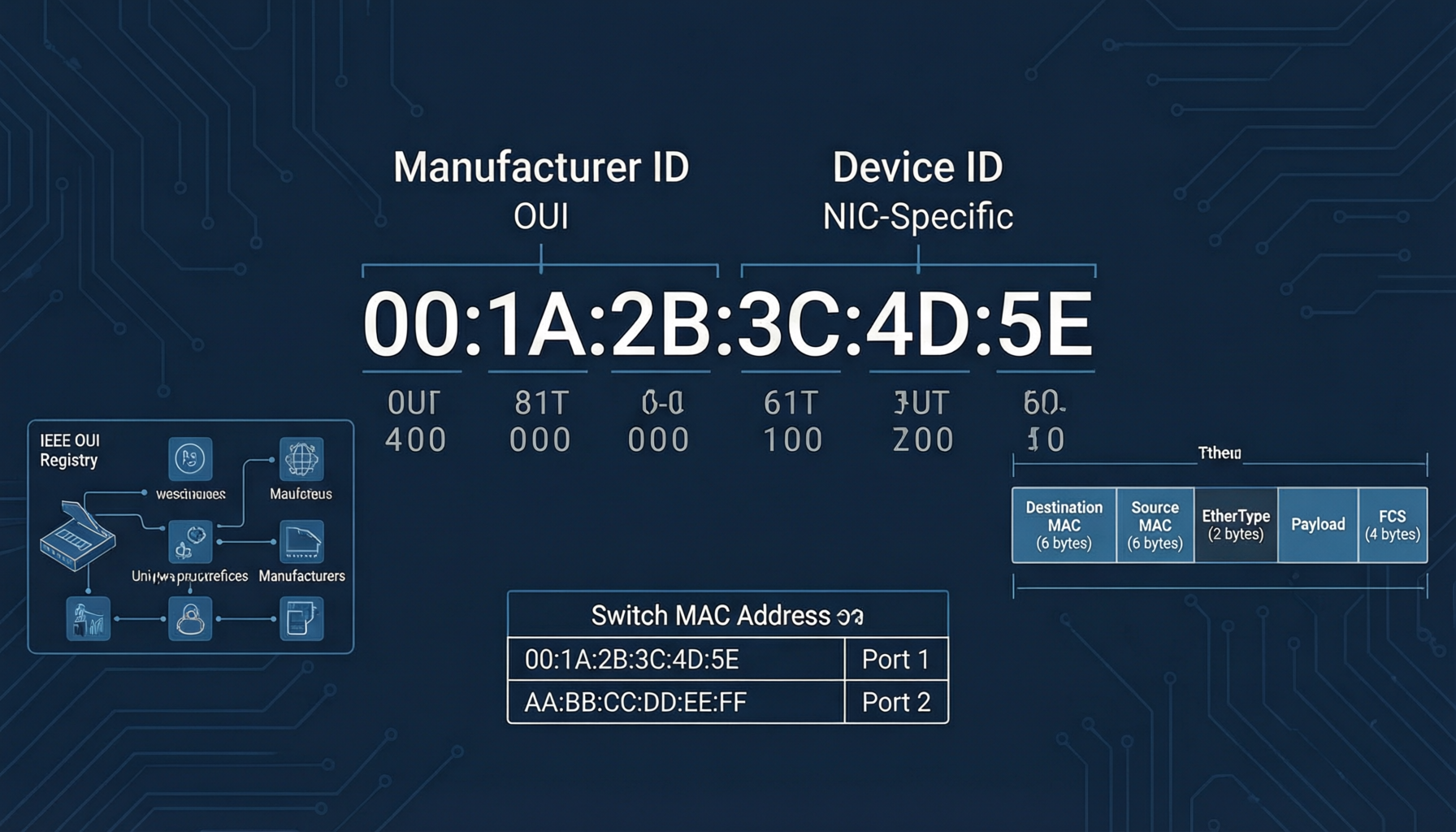
The MAC address structure consists of two distinct parts:
OUI (Organizationally Unique Identifier): The first 24 bits (3 bytes) identify the manufacturer. The IEEE assigns OUIs to vendors, ensuring global uniqueness. For example, 00:1A:2B might be assigned to a specific NIC manufacturer.
NIC-Specific Identifier: The last 24 bits (3 bytes) are assigned by the manufacturer to uniquely identify each individual network interface. This ensures no two NICs from the same vendor share the same MAC address.
When a device sends an Ethernet frame, it includes both the source MAC address (sender) and destination MAC address (receiver) in the frame header. Switches maintain a MAC address table that maps MAC addresses to physical ports, enabling efficient frame forwarding within the local network.
Global Uniqueness: IEEE-managed OUI assignment ensures that every MAC address worldwide is unique, preventing address conflicts in network communication (IEEE Registration Authority).
Hardware-Level Identification: MAC addresses are burned into the NIC firmware, providing a permanent identifier that persists across OS reinstallations and network configuration changes.
Local Network Efficiency: Switches use MAC addresses for Layer 2 frame forwarding, enabling efficient communication within broadcast domains without involving higher-layer protocols.
Security Applications: MAC address filtering allows network administrators to control device access at the switch port level, providing an additional layer of network security.
Ethernet Switching: Network switches maintain MAC address tables to forward frames only to the destination port, reducing unnecessary traffic and improving network efficiency. LR-LINK LRES1015PF-4SFP+ NICs each have unique MAC addresses per port for proper switch integration.
Network Security: MAC address filtering restricts network access to authorized devices. Enterprise switches can be configured to allow only pre-registered MAC addresses on specific ports.
Virtualization: SR-IOV virtual functions each receive unique MAC addresses, allowing VMs to be identified individually on the network while sharing the same physical NIC hardware.
Device Tracking: Network administrators use MAC addresses to track device locations, troubleshoot connectivity issues, and maintain inventory of network-connected equipment.
Related Technologies
NIC has a burned-in MAC address that uniquely identifies it on the network. Modern server NICs like LR-LINK LRES1015PF-4SFP+ assign unique MAC addresses to each of their 4 ports.
VLAN switches use MAC addresses to forward frames within broadcast domains. Each VLAN maintains its own MAC address table for isolated Layer 2 communication.
Jumbo Frame includes MAC addresses in the Ethernet frame header. Whether standard 1500-byte or jumbo 9000-byte frames, the 12-byte MAC address field (source + destination) remains constant.
SR-IOV virtual functions each have their own unique MAC address for network identification. This allows multiple VMs to share a physical NIC while maintaining individual network identities.
A MAC address is the fundamental hardware identifier for network interfaces, providing global uniqueness through IEEE-managed OUI assignment. Operating at Layer 2 of the OSI model, MAC addresses enable efficient local network communication through switch-based frame forwarding. From basic Ethernet switching to advanced virtualization and security applications, MAC addresses remain essential for network device identification and communication.