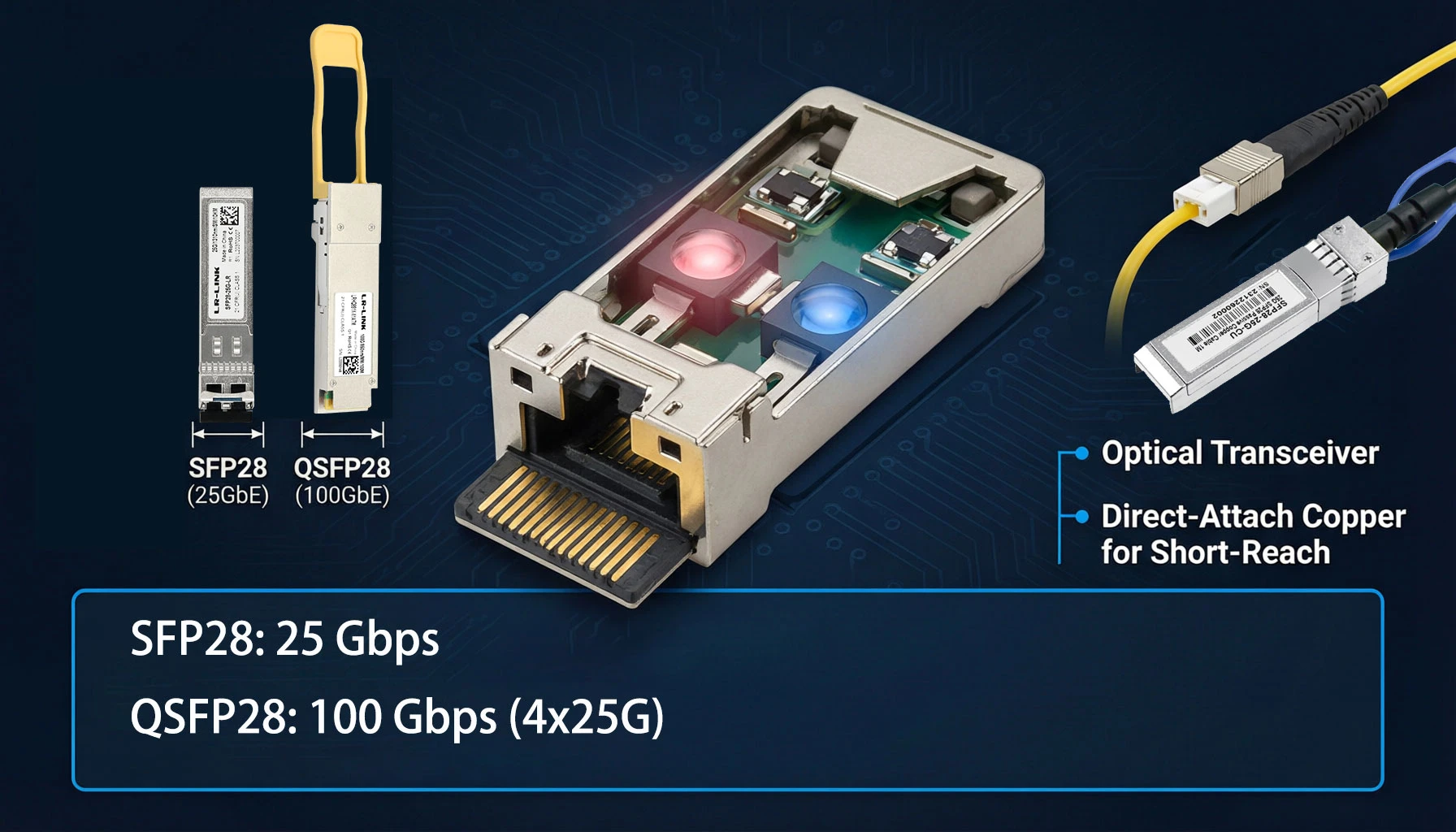
SFP28 (Small Form-factor Pluggable 28) is a 25 Gbps hot-pluggable transceiver form factor defined by the SFF-8402 specification. It shares the same physical dimensions as SFP+ (10GbE) but operates at 25 Gbps per lane, making it the natural evolution for 25GbE networking. SFP28 supports both optical fiber (single-mode and multimode) and direct-attach copper (DAC) connections, and is backward compatible with SFP+ cages, allowing 10GbE modules to operate in 25GbE ports (SFF-8402 Rev 1.2).
SFP28 transceivers convert electrical signals from the host device (NIC, switch) to optical or copper signals for transmission:
Electrical Interface: The SFP28 module connects to the host via a 20-pin gold-plated connector. It uses a single 25 Gbps lane (28 Gbps raw with encoding overhead) for both transmit and receive, implementing 64b/66b encoding for efficient data transfer.
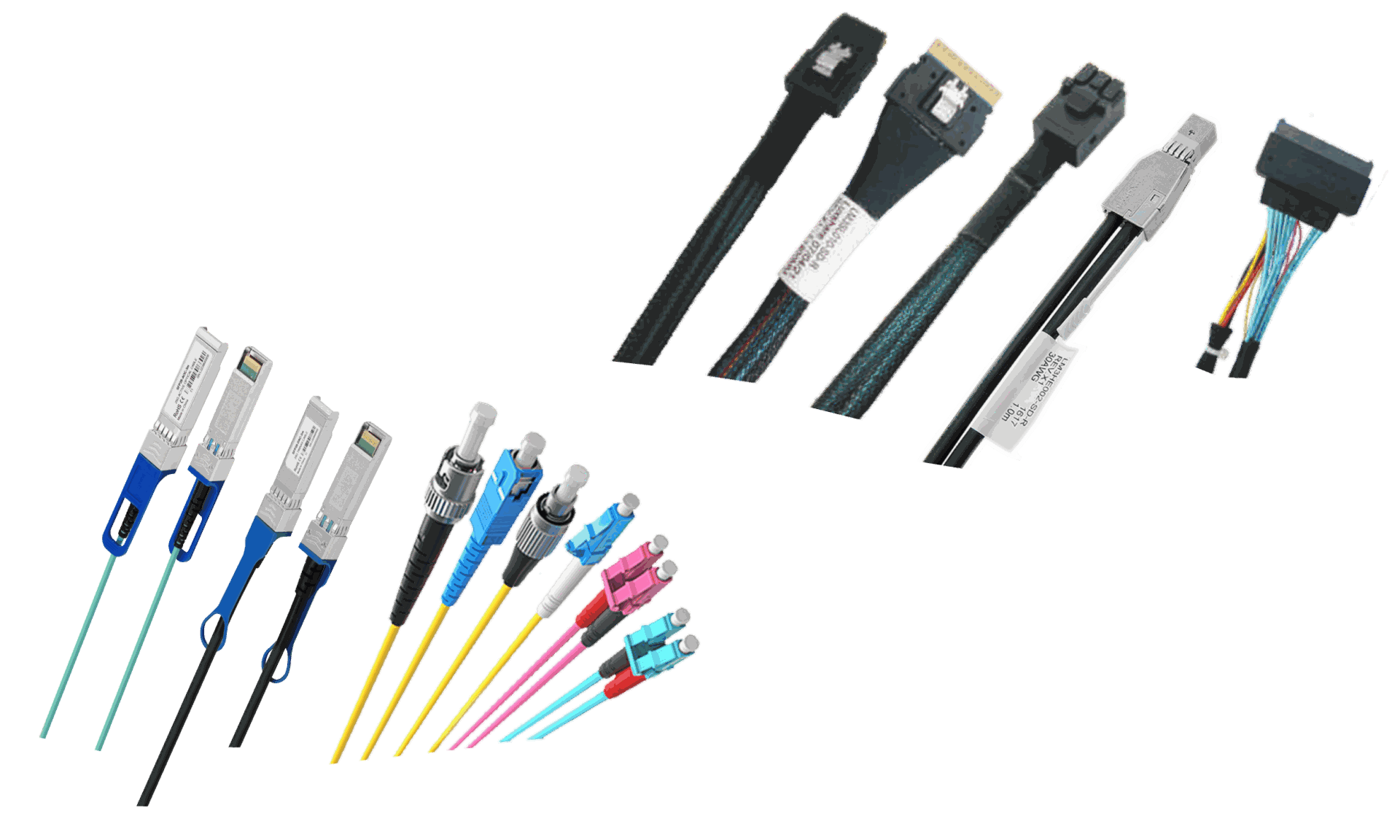
Optical Transceiver: For fiber connections, the module contains a laser (transmitter) and photodiode (receiver). Common variants include SR (short-reach, 850nm multimode, 100m), LR (long-reach, 1310nm single-mode, 10km), and ER (extended-reach, 1550nm single-mode, 40km).
Direct-Attach Copper (DAC): For short-reach connections (≤5m), SFP28 DAC cables integrate the transceiver electronics into the cable assembly, reducing cost and power consumption while maintaining 25 Gbps performance.
Digital Diagnostics Monitoring (DDM): SFP28 modules include real-time monitoring of temperature, voltage, laser bias current, and optical power levels, enabling proactive maintenance and fault detection.
The SFP28 form factor maintains the same 13.4mm × 8.5mm × 56.5mm dimensions as SFP+, ensuring mechanical compatibility with existing SFP+ ports and panel layouts.
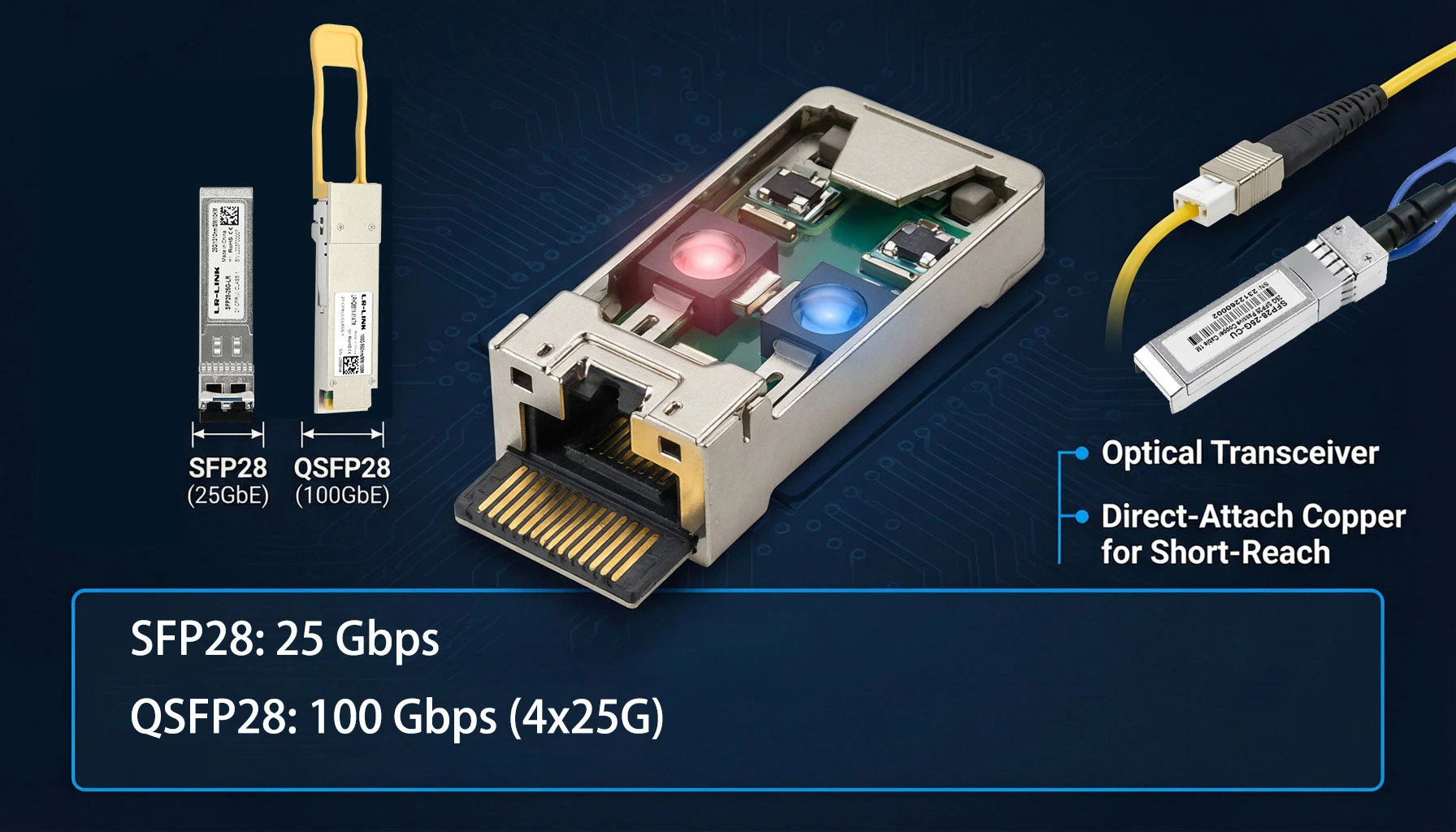
25 Gbps Performance: SFP28 delivers 2.5x the bandwidth of SFP+ (10GbE) while maintaining the same form factor, enabling seamless upgrades from 10GbE to 25GbE without replacing switch hardware (SFF-8402, 2015).
Backward Compatibility: SFP28 ports accept SFP+ modules, allowing mixed 10GbE/25GbE deployments. This protects existing investments and enables gradual migration to 25GbE.
Low Power Consumption: SFP28 modules consume ≤1.5W per port, significantly less than QSFP28 (100GbE) while providing sufficient bandwidth for most server-to-switch connections.
Hot-Pluggable: SFP28 modules can be inserted or removed without powering down the host device, enabling maintenance and upgrades without service interruption.
Data Center Server Connectivity: 25GbE SFP28 has become the standard for server-to-top-of-rack-switch connections in modern data centers. LR-LINK LRES1027PF-4SFP28 provides 4×25GbE ports for high-density server networking.
5G Mobile Fronthaul: Telecommunications operators deploy SFP28 transceivers for 5G baseband unit (BBU) to remote radio head (RRH) connections, requiring low latency and high bandwidth for fronthaul traffic.
High-Performance Computing: HPC clusters use 25GbE SFP28 for compute node interconnects, often combined with RDMA/RoCE for sub-10-microsecond latency in distributed computing workloads.
Storage Area Networks: SFP28 enables 25GbE Fibre Channel (FC-25) for storage networking, providing 2× the bandwidth of 16Gb FC while maintaining backward compatibility with existing FC infrastructure.
Related Technologies
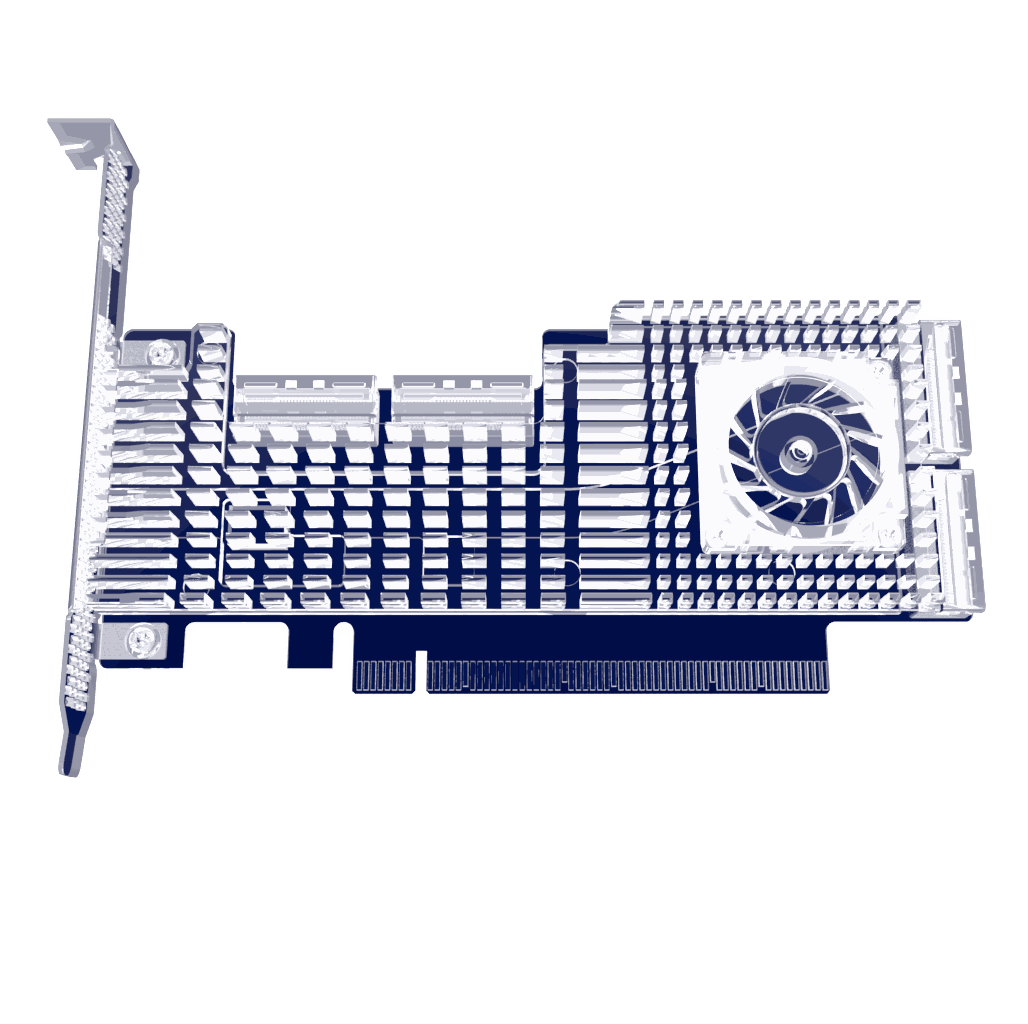
NIC implements SFP28 cages for 25GbE connectivity. LR-LINK LRES1027PF-4SFP28 features 4 SFP28 ports, each supporting 25GbE with backward compatibility to 10GbE SFP+ modules.
PCIe Lane bandwidth must match SFP28 speed requirements. A 25GbE NIC typically uses PCIe Gen3 x8 (8 GB/s) to handle bidirectional 25GbE traffic without bottleneck.
RDMA leverages SFP28 for 25GbE RoCE (RDMA over Converged Ethernet), enabling zero-copy, kernel-bypass networking for low-latency applications.
Jumbo Frame maximizes throughput over 25GbE SFP28 links by reducing per-packet overhead. With 9000-byte frames, 25GbE achieves near-line-rate efficiency for large data transfers.
SFP28 is the dominant 25GbE transceiver form factor, offering 2.5× the bandwidth of SFP+ while maintaining mechanical compatibility. Through its support for optical fiber and DAC connections, hot-pluggability, and digital diagnostics, SFP28 enables flexible, high-performance networking for data centers, 5G infrastructure, HPC clusters, and storage networks. Its backward compatibility with SFP+ ensures smooth migration paths from 10GbE to 25GbE.